


Time not right for stimulus policy exit: China, EU
2009-11-30 09:19 BJT Mail
 Share
 Print
Political and economic leaders from China and the European Union (EU) appealed in Nanjing Sunday that countries should not take an "early withdraw" from their economic stimulus packages since they are still need to maintain the global economic recovery trend.
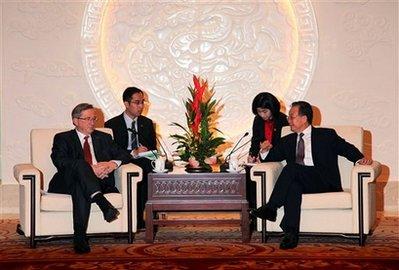 |
| Chinese Premier Wen Jiabao, right, talks with Jean-Claude Juncker, prime minister of Luxembourg and Eurogroup president, left, during their meeting Sunday, Nov. 29, 2009 in Nanjing, China. China should allow its currency to strengthen against the euro and other major currencies, for its own sake as well as that of the global economy, top finance officials of the single-currency euro zone said Sunday. (AP Photo/Eugene Hoshiko) |
"An early withdraw would lead to a loss in what we have achieved," said Chinese Premier Wen Jiabao while meeting with a trio of European leaders ahead of the 12th EU-China summit.
Jean-Claude Juncker, president of the Eurogroup and Luxembourg Prime Minister, also revealed during the talk that the European Union has not yet started to withdraw the stimuli.
"The moment has not yet arrived for withdrawing the stimulus package for both China and the European Union," he told a press conference after the meeting.
The announcement came amid worldwide controversies over a second wave of financial turmoil, as the Dubai debt crisis had given rise to fears and brought shock waves around the world's already brittle stock markets.
"For the Euro area, there will be no major withdrawal of stimulus measures in 2010," Juncker said.
China also announced on Friday that, after launching a four-trillion-yuan (about 585.6 billion U.S. dollars) economic stimulus package, it will continue its proactive fiscal policy and moderately easy monetary policy next year even with growing concerns over possible asset bubbles.
In China, some economists are concerned that loose monetary policy could drive up prices of stocks and housing, and build up unneeded factories and saddle the economy with bad debts. Some are talking about the timing of the stimulus policy exit.
However, China's economic growth has approached its pre-crisis level a year after the adoption of the 4-trillion-yuan economic stimulus package.
The country's economy grew 8.9 percent year-on-year in the third quarter this year, accelerating from 7.9 percent in the second quarter and 6.1 percent in the first quarter. In the third quarter last year, it increased 9 percent year on year.
"There are still possibilities for a second wave of crisis," said Lin Songli, an economist with Guosen Securities in Beijing. He said that, under such circumstances, China must maintain the continuity and stability of its macro-economic development and exercise a pro-active fiscal policy.
Such continuity in China's stimulus package is "in the best interest of both Europe and the world", said Juncker, who gave full recognition to Wen's appeal. More would be discussed on the stimulus and the economic recovery during the 12th EU-China summit, which will be held on Monday here in the eastern China city.




 Video










On CCTV
Get the Channel, CCTV Live, CCTV Live in HD, CCTV-5 (Sports) Live, Latest Video, TV ScheduleCCTV-9 News Programs
Asia Today, Biz China, CCTV News, China This Week, China Today, Culture Express, Dialogue, News Hour, Sports Scene, World Insight, World Wide Watch
Newsletter
RSS
Site Map
|
Contact Us
|
About Us
|
FAQ
|
Jobs
|
Advertise
|
Privacy Policy
|
Terms of Use
 2009 China Central Television. All Rights Reserved