


By Ling Dequan, Researcher of Center for World Affairs Studies,Xinhua News Agency
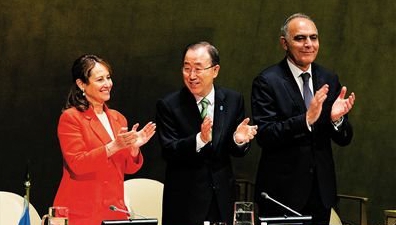
On April 22, Earth Day, 175 world leaders and representatives gathered at the United Nations headquarters in New York to sign the Paris Agreement on climate change, which concerns our “Earth village.”
The agreement would accelerate the UN Framework Convention on Climate Change, offering a blueprint for low-carbon green development.
Climate change challenges
According to a climate research report released by Earth System Dynamics magazine, published by European Geosciences Union (EGU), if global temperatures rise 2 degrees centigrade, our land will suffer from agricultural reductions, water resource shortages, and heat waves, which can double the impact brought by a 1.5-degree rise.
A 0.5-degree rise of temperature leads to 10 centimeters average rise of the ocean surface, which threatens small island countries and coastal areas that endanger global coral reefs.
When temperatures rise by 2 degrees, the climate-induced security hot spots would be enlarged. Fresh water supply on the Mediterranean coast would drop 20 percent. Scientists have also warned that corn and wheat harvests would cut in half.
Experts believe that if the current pace of fossil-fuel consumption continues, global temperatures will rise 4 degrees or more by the end of 21st century. Climate change is associated with people’s development. All countries should reach a consensus to work together.
China’s commitment
China has promoted the Paris Agreement. Last December, President Xi Jinping attended the Paris conference and delivered a speech on China’s proposals, which had won widespread support.
Beijing has communicated with various factions to resolve diplomatic concerns. Chinese Vice Premier Zhang Gaoli, special envoy of Chinese President Xi Jinping, participated in the signing ceremony on behalf of China on April 22.
Zhang said, “China is a responsible developing country, and the Chinese people honor their commitments. We will live up to the innovative, coordinative, green, open and sharing developing concepts to earnestly implement the Paris Agreement. China will continue working hard to fight against climate change.”
He promised, “China will finalize domestic legal procedures to ratify the Paris Agreement on climate change before the G20 Hangzhou summit in September this year. China will work with other countries, and has appealed to G20 members to promote universal approval and implementation of the agreement.”
China has pledged to peak its carbon emissions by 2030. In its 13th Five- Year Plan, it intends to cut its carbon emissions per unit of GDP by 18 percent in the coming five years, and carry out double control over the volume and intensity of energy consumption, build zero carbon emission trial project, launch a national emission trade market, and substantially increase forest carbon sink.
Meanwhile, China has established a strict accountability system for environmental protection. Beijing will also deepen South-South cooperation on climate change.
Paris Agreement gets implemented
China is cooperating with the UN, United Sates, France and other countries and regions to achieve real progress. The US and China are the world’s largest and second largest economies, and the two biggest greenhouse gas emission countries respectively. Their joint efforts highlight stronger bilateral ties.
Washington and Beijing have issued three joint statements on climate change. The two countries can enjoy win-win cooperation with common interests and responsibilities to tackle world energy security and development.
They have deepened cooperation on sustainable global energy development. The Paris Agreement was reached last November. It is the second agreement on climate change with legal binding, after the Kyoto Protocol, which stipulates global actions after 2020.
After the signing, the Paris Agreement still needs at least 55 nations that account for 55 percent of global greenhouse gas emissions to ratify before it can enter into force.Signing the agreement is the first step. The Paris Agreement might become effective before 2020. The coming challenges are about implementation for each country, namely how to peak greenhouse gas emissions to keep global temperature within a 2-degree or 1.5-degree rise.
New rounds of negotiations on climate change this May in Bonn, Germany and at the Marrakesh of Morocco will occur later this year. All members of the “Earth Village” can coordinate to build a better world for our descendants.
Ling Dequan
( The opinions expressed here do not necessarily reflect the opinions of Panview or CCTV.com. )

Panview offers an alternative angle on China and the rest of the world through the analyses and opinions of experts. We also welcome outside submissions, so feel free to send in your own editorials to "globalopinion@vip.cntv.cn" for consideration.