

From the depths of the sea to outer space, China's "creative industry" is an economic powerhouse. That's the message from the 12th China International Cultural Industry Fair, now underway in the southern city of Shenzhen.
Shenzhen, regarded as one of the most creative cities in China, is today a showcase for the nation's cultural talent.
But this isn't your average culture fair. Here, the term is being interpreted broadly - to include sea exploration, space travel, and even the military. Right next to me is a model of the Jiaolong submersible, a milestone in Chinese scientific exploration. This unmanned sub has logged 120 days beneath the waves and has plunged as deep as 7 kilometers!
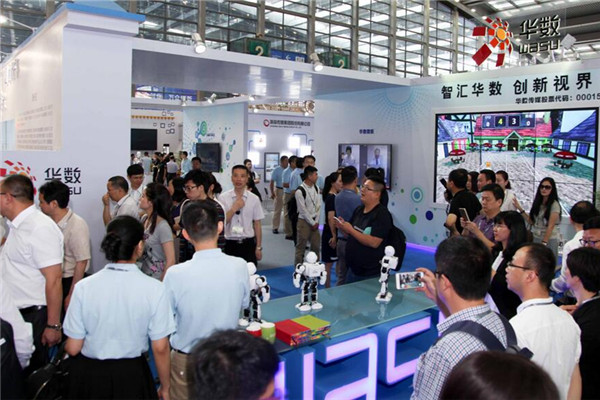
The term is being interpreted broadly - to include sea exploration, space travel, and even the military.
A model of China's Tiangong Space Station is also on display. It's a symbol of China's rapid development in aerospace technologies.
"In the past, we only focused on national defence research but didn’t do enough to promote military culture. In the future, we hope to make national defence an integral part of the entire Chinese culture," said Yuan Heping, State Admin. of Sci & Tech of National Defense.
I'm now in the pavilion of Guangdong Province. This device looks like something you might see in an amusement park, but actually it’s a virtual-reality game. Six people can sit in a circle, form a team, and be "transferred" to a battle field.
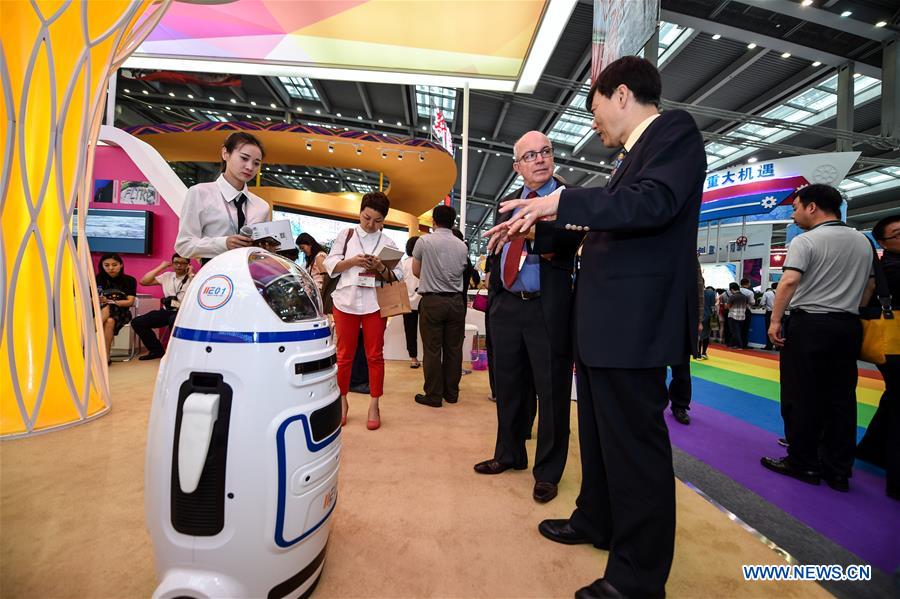
An exhibitor introduces a life-serve robot to visitors.
Looking around, you soon realise Chinese culture isn't only about history, the Great Wall, and Chinese food. The country is trying hard to add more meaning to the term. Other countries are also keen to work with China, embracing cultural exchange and the so-called "Belt and Road" initiative proposed by Chinese president, Xi Jinping.
Russia has a part to play in that story too and boasts the largest pavilion at the fair. Among the 34 other nations with pavilions are Germany, Malaysia, and Egypt.