

The Huzhou writing brush has always been revered for its craftsmanship. And to trace the origin and the story behind the making of the writing brush, one of the four scholarly treasures, a group of college students from Taiwan have travelled to Huzhou for a 22-day summer camp.
"You picked the hair out, is it still useful?"
"Yes, it could be used as the inner part of the brush."
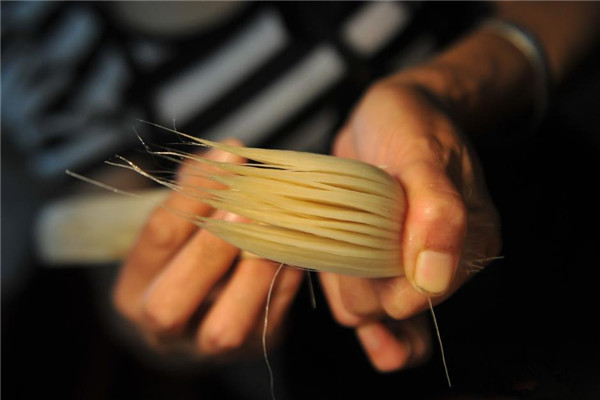
The Huzhou writing brush has always been revered for its craftsmanship.
Luo Yujun started learning Chinese calligraphy at the age of ten. Now a senior in college, he is still a big fan of the traditional art. This is the first time the student from Taiwan has actually witnessed the manufacturing process of a writing brush.
"I use writing bushes and I'm quite familiar with them, but I had no idea about how it's actually made. I'm surprised that it takes so many steps to make a writing brush. It's very complicated. The visit is really an eye-opener," Luo Yujun said.
And many of the visitors even got a chance to have a go at making the brush themselves.
They chose handles from red sandalwood, mottled bamboo and white porcelain, and the hair of the brush from rabbit hair, weasel hair or a mixture of goat and weasel hair.

A group of college students from Taiwan have travelled to Huzhou for a 22-day summer camp.
"We got to know more about the production method of writing brushes, their origin and history. It makes a difference to be here in the mainland to see and experience Chinese culture in person," said Zeng Xinyu, Taiwan college student.
In the next 20 days, the young visitors from Taiwan will also have a calligraphy exchange with local college students, and learn about silk production.